
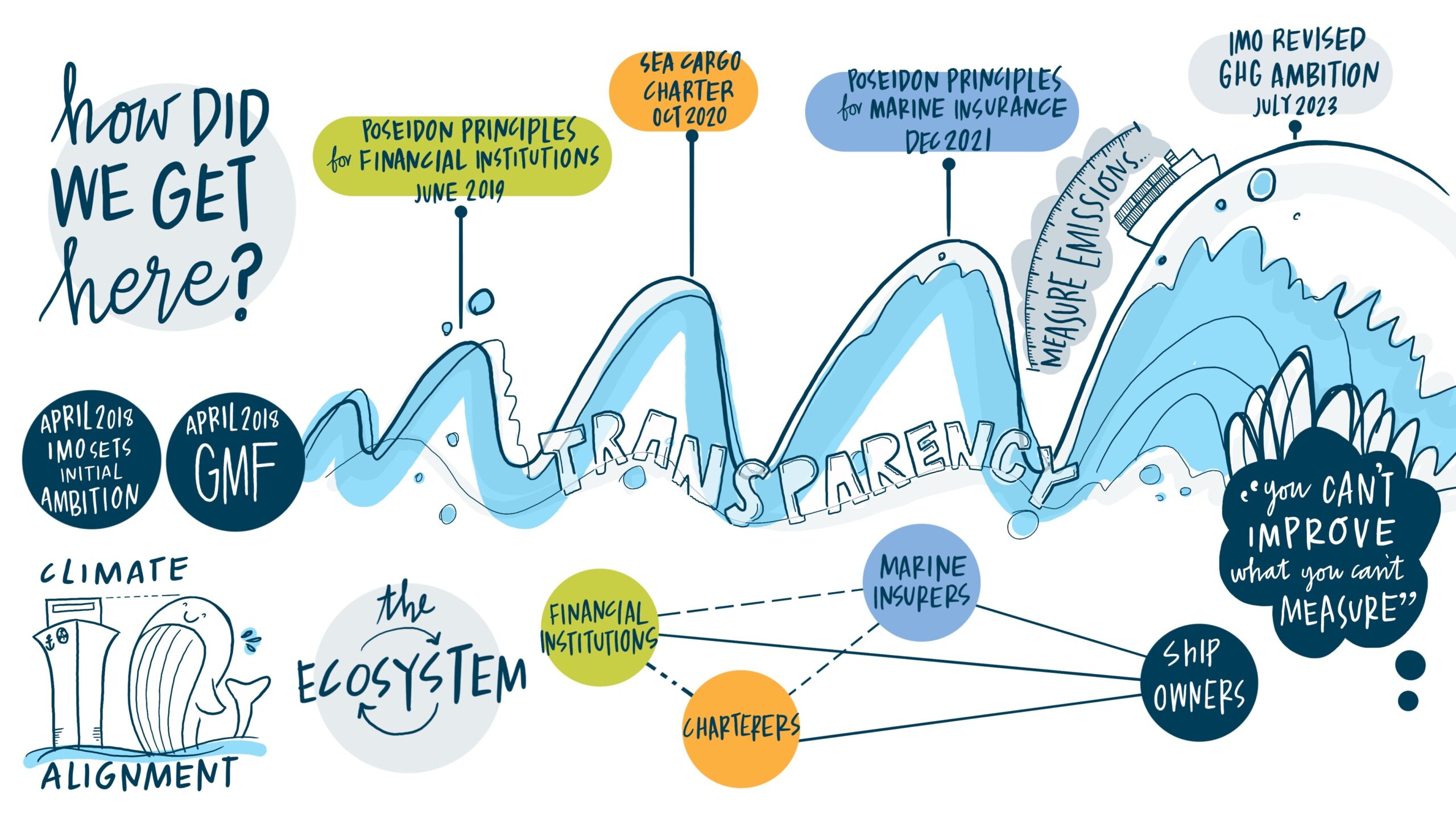
How did we get here
The Poseidon Principles were launched in 2019 in New York City with eleven signatories. The framework was developed through an effort spearheaded by global banks (Citi, Societe Generale, and DNB) in collaboration with leading maritime companies (A.P. Møller Mærsk, Cargill, Euronav, Gram Car Carriers, Lloyd’s Register, and Watson Farley & Williams). The development process was supported by the Global Maritime Forum, Rocky Mountain Institute, and UMAS.
 Read the press release from launch.
Before launch, a series of three workshops held in June 2018 across Singapore, London, and New York City brought together 45 senior ship financiers, along with a select group of ship owners and experts, to explore practical approaches to integrating climate risk into financial decision-making in the maritime industry. Throughout these workshops, there was a shared vision of success: a group of aligned and committed institutions taking ownership of a set of principles to integrate climate considerations into lending decisions, in line with the IMO’s climate-related goals.
A drafting group of leading banks, key industry stakeholders and experts was subsequently convened to develop what is now the Poseidon Principles. Shipowners of varying sizes and geographies, as well as other experts and stakeholders, have been engaged and consulted throughout the process of developing the Poseidon Principles.

While climate alignment is the only metric considered currently, the framework is intended to evolve over time to include other issues where the collective influence of financial institutions can help improve the international shipping industry. Some members may choose to go beyond the global baselines established by the Poseidon Principles, which in turn supports the overall development of the principles and the shipping industry as a whole.
Collaboration with similar transparency frameworks
By making valuable asset-level climate alignment data available to financial institutions, the Poseidon Principles aim to support other frameworks, including the Task Force on Climate-related Financial Disclosures (TCFD), the Principles for Responsible Banking, the Carbon Disclosure Project, and the Energy Transitions Commission. Other transparency initiatives, such as those led by Science Based Targets (SBTi) and the Net Zero Bank Alliance (NZBA), acknowledge that the Poseidon Principles have set the standard for climate-related disclosure by financial institutions.
During the early stages of the development of the Poseidon Principles, charterers that were part of the drafting group voiced the need for a similar transparent process for reporting emissions relating to chartering activities. This eventually gave rise to the Sea Cargo Charter in October 2020. The Poseidon Principles and the Sea Cargo Charter maintain a close collaboration to promote maritime decarbonisation and are both supported by the Global Maritime Forum.
Similarly, from 2021 to 2026, the Poseidon Principles for Marine Insurance (PPMI) brought together a group of marine insurance institutions committed to aligning their portfolios with responsible environmental practices based on the same four principles. In December 2025, the Poseidon Principles broadened its membership framework by introducing associate membership, presenting a natural opportunity to explore ways to align reporting across the financial sector. Associate membership was then opened to the marine insurance sector in September 2026, bringing the Poseidon Principles and the PPMI together under a single, unified framework to strengthen shipping’s decarbonisation efforts.
POSEIDON PRINCIPLES
Get in touch
Where to find us
Amaliegade 33 B, 3rd floor
1256 Copenhagen K
Denmark
VAT Number: 40632379
Follow us